Blog / Hammond GMC Dealer

Blog

All Hammond GMC Dealer Hammond GMC Service
GMC Acadia Trim Levels Comparing AT4 and Denali Models

GMC Acadia Trim Levels Comparing AT4 and Denali Models

GMC Acadia trim levels give you two distinct paths when comparing AT4 and Denali. Both share the same core engine and three row layout. However, their equipment changes what you encounter from the driver seat. AT4 adds hardware for traction and rougher surfaces. Denali places greater focus on seating, displays, and cabin convenience. What AT4 and Denali Share Do Acadia AT4 and Denali use different engines? Both use the same 2.5L Turbo engine and eight speed automatic transmission. GMC rates that engine at 328 horsepower. Therefore, engine output does not separate these two trims. The larger differences appear in the chassis, traction hardware, cabin materials, and convenience equipment. Both trims also retain seating for seven. Their published cargo volume reaches 97.5 cubic feet behind the first row. As a result, choosing AT4 does not require surrendering the Acadia's core passenger or cargo layout. Each trim also includes the large central infotainment display found across the current Acadia lineup. Available Super Cruise further extends the technology choices for either configuration. That shared foundation matters during a GMC Acadia trim comparison. You can focus on the equipment that changes without treating them as entirely different SUVs. How Acadia AT4 Changes the Chassis AT4 separates itself through hardware beneath and around the vehicle. What does AT4 change beyond exterior styling? The answer starts with its AWD hardware, suspension tuning, tires, ride height, skid plates, and Terrain Mode. Active Torque Control AWD can send torque between the front and rear axles. It can also distribute torque between the rear wheels. Therefore, power can move toward the wheel positions with available traction. Terrain Mode adds another tool for slow travel across rough surfaces. The mode can manage low speed movement through accelerator input. That setup gives you another method for controlling the Acadia during careful off pavement travel. AT4 also changes several physical components that meet the road or protect the underside. All terrain tires: These tires carry tread suited to mixed surfaces beyond ordinary paved roads. Lifted ride height: Additional ground clearance creates more space between lower vehicle components and uneven surfaces. Skid plates and suspension tuning: These components support the AT4's focus on rougher routes and uneven terrain. These changes explain why AT4 feels different without receiving another engine. The distinction comes from how the chassis handles traction, clearance, and surface changes. For Louisiana travel, those traits can matter beyond dedicated trails. Gravel drives, camp access roads, wet grass, and uneven property entrances can place traction hardware into regular service. How Acadia Denali Changes the Cabin Denali takes a different approach within GMC Acadia trim levels. Its major changes concentrate inside the cabin instead of adding AT4 terrain hardware. What does Denali add inside the Acadia? GMC includes leather appointed first and second row seating, plus heated and ventilated front seats. It also includes an eight inch Head Up Display. The Head Up Display places selected information within the driver's forward sightline. Therefore, you can view key data without shifting your eyes toward the center display. Ventilated front seats address a separate cabin task. Air movement through the seating surfaces can make hot weather trips more comfortable. That can stand out during Louisiana summers and long stretches in direct sun. Denali also adds powered functions for the rear seating area. Power folding third row seats reduce the manual work involved when changing the cargo layout. One touch second row folding provides another quick route into a larger storage configuration. These items change different moments inside the cabin. Some support the driver, while others focus on seating or cargo conversion. For this reason, Denali is more than an appearance package. Its equipment changes how you interact with information, seats, and interior space. How the Two Trims Feel Different From the Driver Seat AT4 and Denali begin from the same Acadia powertrain, yet they communicate their differences through different parts of the vehicle. AT4 places more of its distinction beneath you. AWD torque distribution, suspension tuning, tire construction, and ride height shape how the chassis responds to changing surfaces. Denali places more of its distinction around you. Seating materials, ventilation, the Head Up Display, and powered rear seats change cabin interaction. That separation gives you a useful way to evaluate both trims. Ask where you want the extra equipment to work most. If rough access roads are common, AT4 hardware deserves closer attention. If most trips remain paved, Denali cabin equipment may receive more frequent interaction. Still, both trims retain the Acadia's three row structure and shared engine output. You are choosing where GMC places the trim specific equipment, not choosing between unrelated vehicle formats. A test drive can make that distinction easier to recognize. Spend time checking visibility, seating position, display placement, and steering response. Then, inspect the tires, ride height, and cargo access before comparing your notes. Matching AT4 or Denali to Your Driving Plans Choosing between these GMC Acadia trim levels becomes clearer when you connect equipment with your usual routes and passengers. Start with where the Acadia will travel, then consider which cabin items you will interact with most. The strongest reasons for choosing each trim come from different priorities. Choose AT4 for terrain focused hardware: Active Torque Control AWD, all terrain tires, extra clearance, skid plates, and Terrain Mode define its direction. Choose Denali for cabin focused equipment: Leather appointed seating, ventilation, the Head Up Display, and powered rear seating lead its direction. Compare both when your needs overlap: Shared seating, cargo room, engine output, and available technology keep either trim open for family travel. Neither choice requires abandoning the core Acadia layout. Instead, the decision centers on which equipment earns its place in your routine. Ross Downing GMC can show you current Acadia AT4 and Denali inventory in Hammond. Seeing both trims together gives you a direct way to inspect their hardware and cabin differences. Bring your normal driving plans into that comparison. Think about your roads, passengers, cargo, and time behind the wheel. Those details give the AT4 versus Denali decision a much clearer direction.

GMC ProGrade Trailering Guide for Sierra Accessories

GMC ProGrade Trailering Guide for Sierra Accessories

GMC ProGrade Trailering gives Sierra owners integrated tools for hitch setup, trailer information, and towing preparation. Yet those tools are only one part of a complete towing setup. Physical hardware, bed protection, wiring, and trailer braking equipment still need their own review. Therefore, a good setup starts by matching each part to the truck and trailer. How GMC ProGrade Trailering Fits the Full Setup GMC ProGrade Trailering brings several integrated trailering tools into the Sierra. Available equipment can include Hitch Guidance, Hitch View, and the In Vehicle Trailering App. Together, these tools support trailer setup, connection checks, and stored trailer information. However, integrated trailering technology does not replace the physical connection between truck and trailer. A receiver, ball mount, hitch ball, safety chains, and electrical connector still handle separate jobs. The trailer itself may also require compatible braking hardware. What does GMC ProGrade Trailering handle? It supports setup and monitoring through truck based technology. By contrast, the hitch and wiring create the mechanical and electrical connection to the trailer. That distinction keeps accessory shopping clearer. You can review factory trailering features first, then identify the hardware your trailer requires. Therefore, each purchase serves a defined part of the towing setup. Choosing a Sierra Bed Liner A Sierra bed liner protects the cargo box from scratches, impacts, moisture, and surface wear. The right material should match what you place in the bed and how you load it. Spray applied liners bond directly to the bed surface. They create textured coverage across the floor, walls, and other coated areas. Molded liners sit inside the bed as a separate shell. Bed mats cover the floor while leaving the bed walls uncovered. Before choosing a liner, consider how cargo moves inside the bed during loading and transport. Different liner styles manage grip, removal, cleaning, and impact protection in different ways. Spray applied liners: These create permanent textured coverage and suit frequent loading of tools, lumber, equipment, or loose cargo. Molded liners: These create a removable protective shell and suit owners who want replaceable bed coverage. Bed mats: These protect the bed floor and add grip while leaving the side walls open. Which bed liner makes sense for your Sierra? Start with the cargo that will contact the bed most. Then, consider whether permanent coverage or removable protection fits your routine better. Matching Hitch and Wiring Equipment to the Trailer The hitch connection starts with hardware that matches both the Sierra and the trailer. The receiver accepts the ball mount, while the hitch ball connects with the trailer coupler. Safety chains create a secondary connection between the truck and trailer. Electrical wiring handles another part of the setup. Trailer connectors carry signals for lights and compatible trailer brakes. Therefore, the connector must match the trailer wiring arrangement. What hardware connects a Sierra to the trailer? The answer starts with the receiver, ball mount, hitch ball, safety chains, and electrical connector. Each part serves a separate task during towing. Ball size and mount height also need attention. The hitch ball must fit the trailer coupler, while mount height supports a level trailer stance. A poor match can place the trailer at an improper angle before the trip begins. Therefore, hitch parts should be selected as one connection package. Choosing pieces separately can create mismatches between the truck, coupler, and trailer height. When a Trailer Brake Controller Matters A trailer brake controller sends braking input from the Sierra to compatible electric trailer brakes. The controller works through the trailer wiring connection and responds when the truck slows. This setup gives the trailer its own braking response instead of relying only on the truck. Therefore, the controller, wiring, and trailer brakes need to work together correctly. When does a trailer brake controller matter? It matters when the trailer uses compatible electric brakes and the towing setup calls for controlled trailer braking. The trailer design and local requirements should guide that review. The controller also needs proper adjustment. Too little braking input can leave the trailer doing less braking work than intended. Too much input can make trailer braking feel abrupt. For this reason, adjustment should reflect the loaded trailer and its braking response. A different trailer or load may require another check before towing. Building a Work or Recreation Setup A complete Sierra accessory plan should reflect what the truck carries and what it tows. A work truck may spend more time hauling tools, lumber, or job materials. A recreation focused Sierra may carry coolers, camping gear, boat equipment, or trailer supplies. Because those routines place different demands on the truck, accessory priorities can change. Bed protection may lead one setup, while covered storage or trailer equipment may lead another. Work setup: Consider durable bed protection, cargo control, hitch hardware, wiring, and trailer braking equipment for frequent hauling. Recreation setup: Consider bed protection, covered storage, trailer connections, wiring, and braking equipment matched to boats or campers. GMC ProGrade Trailering can support either setup through its integrated trailering tools. Still, the physical accessories should match the trailer and cargo you plan to use. Ross Downing GMC can review current Sierra equipment and available accessory choices for your truck. Bring your trailer details, cargo plans, and towing routine into that conversation. Therefore, you can compare accessories around the work your Sierra will handle after delivery.

GMC Trade In Value Guide for Trading Your Sierra Truck

GMC Trade In Value Guide for Trading Your Sierra Truck

GMC trade in value matters when you are preparing to move from your current truck into a new Sierra. A clear appraisal process starts with your specific truck, its history, and its present mechanical and cosmetic state. Therefore, knowing what the dealership reviews can make the visit easier to follow. You can also arrive prepared for payoff questions, paperwork review, and the final appraisal discussion. What Goes Into a GMC Sierra Appraisal A dealership appraisal reviews your Sierra as a complete truck, not as a mileage number alone. Staff start with basics such as model year, trim, engine, drivetrain, odometer reading, and installed equipment. Then, they inspect the exterior, cabin, tires, bed, glass, lights, and other visible areas. In addition, service history and reported damage may provide context for the truck's current state. Several inspection areas give the appraisal team specific information about the truck. Each area contributes a different piece of the valuation review. Exterior and bed: Staff inspect body panels, paint, glass, tailgate surfaces, and the bed for damage or visible repair needs. Tires and mechanical components: Tire wear, suspension components, brakes, and visible maintenance items may indicate upcoming reconditioning needs. Interior and equipment: Cabin condition, factory equipment, installed accessories, and working controls contribute to the complete vehicle review. GMC trade in value also reflects market information beyond the truck itself. Appraisers may review recent auction data, regional demand, similar inventory, and expected repair costs before setting an offer. Therefore, two Sierra trucks from the same model year can receive different figures. A higher trim, lower mileage, desirable equipment, and cleaner history can support a stronger appraisal result. What does the dealership inspect before assigning a value? The appraisal combines physical inspection, vehicle records, equipment, mileage, and current market data. Because each input tells a different part of the story, no single number controls the entire result. For this reason, an online estimate works best as a starting point, not a final offer. Does Towing or Truck Work Change the Appraisal Towing or hauling history does not set GMC trade in value by itself. Appraisers look for the physical evidence that past work may have left behind. That review can include the receiver area, bed floor, tailgate, tires, suspension components, and visible maintenance items. Furthermore, they may note aftermarket towing hardware or modifications that change resale demand. A Sierra used for trailers can still present well at appraisal time. Service records can show fluid changes, brake work, tire replacement, and other care completed during ownership. However, uneven tire wear, damaged bed surfaces, worn hitch hardware, or neglected maintenance may signal future repair expense. Those items can shape the final figure because the dealership may need to prepare the truck for resale. GMC trade in value can also reflect factory equipment that supports towing or work. Features such as an integrated trailer brake controller, factory hitch equipment, or trailering cameras can strengthen the truck's appeal. By contrast, some aftermarket changes may narrow the pool of future customers. The appraiser will consider whether installed equipment fits current local demand. Should you remove every accessory before the appraisal? No. Start by identifying which parts are factory installed, dealer installed, or aftermarket. Then, bring receipts or service records when they clarify the work completed. That documentation gives the appraiser more context without requiring you to reverse useful upgrades before the visit. Can You Trade a Sierra With an Active Loan You can trade a Sierra even when you still owe money on the loan. The dealership requests a payoff amount from your lender and compares that figure with the appraisal. Therefore, the trade offer and the loan payoff remain separate numbers until the equity is calculated. Positive equity means the GMC trade in value is higher than the lender payoff. That remaining amount can be applied within the next purchase transaction. Negative equity means the payoff is higher than the appraisal figure. In that case, the difference still has to be resolved as part of the transaction. For this reason, the loan balance shown in an online account may not match the payoff quote exactly. Interest can continue to accrue, and the lender may include specific payoff timing. Additionally, some lenders provide payoff instructions directly to the dealership. Having your lender name and account information ready can reduce delays during the review. What if you recently made a payment? Tell the dealership when the payment was submitted. The lender's current payoff figure controls the calculation, so recent account activity needs current verification. Consequently, the finance team may request an updated payoff before final paperwork is completed. Preparing for Your Sierra Trade Preparation gives you a clearer path from appraisal to the next truck. Start by gathering the records and items connected with ownership, financing, and maintenance. Having them together can keep verification work moving during the dealership visit. Bring the items available for your specific Sierra before the appraisal begins: Identification and ownership records: Bring identification, registration, and available title information for ownership verification. Lender information: Have your lender name and account details ready when a loan remains on the truck. Keys and service records: Bring available key sets, maintenance records, accessory receipts, and documentation for major completed work. If a lender holds the title, the dealership can explain what verification it needs from you. Moreover, bringing available records keeps important details together during the visit. GMC trade in value is easier to discuss when you understand the appraisal inputs before the offer appears. You should know the truck's trim, mileage, major factory equipment, recent service work, and any known damage. However, you do not need to make the truck look new before arriving. A basic cleaning can make inspection easier, but major last minute repairs may not return their full cost. The appraisal itself usually follows a straightforward sequence. Staff identify the truck, inspect its visible state, review key records, confirm market information, and prepare the offer. If a loan remains, the payoff review follows alongside the appraisal. As a result, the final discussion can cover both the truck's value and the amount still owed. Once those figures are clear, you can compare the trade with your plans for a new Sierra. A Ross Downing GMC team member can also explain how the appraisal connects with available Sierra inventory. Still, the strongest starting point is understanding your current truck before discussing the next one. Moving From Your Current Truck Into a New Sierra Trading your current Sierra should feel like a clear financial and mechanical review, not a guessing exercise. GMC trade in value starts with the truck you own, the care it received, and the market around it. Furthermore, towing history, mileage, equipment, payoff status, and visible wear each contribute separate information. If you are preparing for a new GMC Sierra in Hammond, bring the records that tell your truck's story. Know your lender information, gather both keys, and be ready to discuss service work or modifications. With that in mind, you can review the appraisal with a clearer sense of how each figure was reached. Ross Downing GMC can walk through the appraisal, payoff details, and available Sierra options during the same visit. The goal is simple: understand the truck you are trading before deciding what comes next.

GMC SUV Lineup for Comfortable Louisiana Road Trips

The GMC SUV lineup gives Louisiana travelers four distinct choices for passengers, luggage, highway miles, and trailer needs. Terrain, Acadia, Yukon, and Yukon XL each place space in a different area. Therefore, the right match starts with the seats used during a normal trip. It also starts with the bags, coolers, strollers, or outdoor gear traveling behind them. How Trip Size Shapes the GMC SUV Choice Which GMC SUV fits a Louisiana road trip? The answer starts with passenger count, occupied seat cargo room, route length, and trailer needs. Maximum cargo figures can mislead when every rear seat must stay raised. Therefore, compare space behind the last occupied row before reviewing total cargo volume. A couple traveling to the Gulf may need room for two bags and a cooler. A family of six may need three rows plus space for luggage. In addition, a group towing a boat must account for people, cargo, hitch weight, and trailer equipment. Use these questions before comparing models: more How many seats will remain occupied for most of the trip? Which bags and large items must stay behind the last occupied row? Will the route include a trailer, city parking, or a small garage? These answers place each SUV in a clearer role. Terrain favors a smaller travel group and easier parking. Acadia adds a third row without full size dimensions. Yukon provides a larger cabin and stronger trailer options. Yukon XL extends cargo room behind the third row. When Terrain Fits a Louisiana Road Trip Terrain seats five and uses two seating rows. Current GMC figures list 29.8 cubic feet behind the second row. With that row folded, maximum cargo volume reaches 63.5 cubic feet. Therefore, Terrain can suit couples, smaller households, and travelers with lighter packing plans. Its smaller exterior also makes city stops easier. Parking near restaurants, hotels, and crowded attractions may require less planning. In addition, a shorter body can make a home garage easier to use. Terrain works well when every traveler can sit within two rows. It also works when luggage fits behind the second row without blocking rear visibility. However, five occupied seats leave no spare row for extra bags. Before choosing Terrain, place normal luggage in the cargo area during a dealership visit. Check stroller length, cooler height, and suitcase width. Furthermore, sit in both rows for several minutes. A quick seating check may miss pressure points that appear later on the highway. When Acadia Provides the Middle Position Acadia adds three rows and seats up to eight. Current GMC figures list 23 cubic feet behind the third row. Folding the second and third rows opens up to 97.5 cubic feet. Therefore, Acadia creates more seating choices while keeping a midsize footprint. That 23 cubic foot figure deserves close attention. Eight seating positions do not guarantee room for eight large suitcases. Consequently, a full passenger load may require soft bags, careful packing, or an approved exterior carrier. Acadia makes sense when the third row serves children, occasional adult riders, or part of a larger group. It also suits households needing three rows during trips but fewer seats during normal errands. Furthermore, current Acadia trims can tow up to 5,000 pounds when properly equipped. A trailer plan still requires the exact rating, payload label, hitch weight, passengers, and cargo. The published maximum should never replace math for the chosen SUV. For long trips, test third row entry, charging access, climate flow, and seat position. These details shape comfort after several hours. They also reveal whether Acadia supplies enough room without moving into Yukon dimensions. When Yukon Supports Larger Groups and Trailers Yukon is a full size three row SUV with seating for up to eight. Current GMC figures list 25.5 cubic feet behind the third row. Space rises to 72.5 cubic feet behind the second row. With rear seats folded, maximum cargo volume reaches 122.8 cubic feet. The larger cabin gives adults more room across longer trips. Yukon also offers gasoline and diesel engine choices across the current range. Therefore, it deserves attention from households carrying people, gear, and a trailer. Still, towing requires more than selecting the largest SUV. Passengers, luggage, accessories, and trailer tongue weight share the payload limit. In addition, engine, drivetrain, axle, hitch equipment, and trim can change the published rating. Yukon may fit families who use all three rows but carry moderate luggage. It may also suit boat, camper, or utility trailer trips. However, its size asks for more parking space than Terrain or Acadia. Measure the home garage and frequent parking areas before choosing Yukon. Check overall length, mirror width, and liftgate clearance. These simple measurements can prevent daily frustration after the road trip ends. When Yukon XL Cargo Space Becomes Necessary Y ukon XL extends the body behind the passenger cabin. Current GMC figures list 41.5 cubic feet behind the third row. That is 16 cubic feet more than Yukon provides in the same area. Therefore, Yukon XL stands apart when every row stays raised. Maximum cargo volume reaches 144.5 cubic feet with the rear seats folded. Space behind the second row reaches 93.6 cubic feet. These figures support large luggage loads, sports gear, travel supplies, and bulky family items. The longer body also brings a larger fuel tank in current Elevation and AT4 specifications. Yukon XL lists about 28 gallons, while Yukon lists about 24 gallons. Yet tank size alone does not establish highway range. Engine, drivetrain, speed, load, and trailer use all change fuel stops. Yukon XL fits groups that need three occupied rows plus substantial luggage room. It also fits households that carry large gear without folding passenger seats. By contrast, the extra length requires more garage depth and parking planning. A test drive should include a tight parking lot and a familiar route. Additionally, test the rear camera views and liftgate space. The largest cargo area has limited value when the SUV cannot fit its normal parking area. Match the SUV With the Normal Trip The final choice should reflect the trip that happens most, not the rare trip that happens once. Terrain serves smaller groups with lighter cargo. Acadia adds three rows while retaining midsize dimensions. Yukon supports larger people, gear, and trailer plans. Yukon XL adds the most room behind an occupied third row. Before selecting a GMC SUV, confirm these details: Count the seats that will remain occupied during a normal trip. Load the usual bags, cooler, stroller, or sports gear during an in person review. Compare the exact fuel, payload, and trailer figures for the chosen configuration. Measure garage depth, parking space, and liftgate clearance at home. Test charging points, climate controls, cameras, and every seating row. Ross Downing GMC gives travelers near Hammond a place to compare each model in person. Bring the people and gear that shape the trip whenever possible. Therefore, the cabin test becomes more useful than a simple walkaround. Louisiana travel may include interstate miles, downtown parking, Gulf trips, or boat launches. Each route places different demands on space and maneuvering. The right GMC SUV should carry the normal group comfortably while keeping luggage, fuel stops, and parking manageable.

GMC Sierra Cab Configuration for Passenger and Bed Needs

A GMC Sierra cab configuration controls where the truck carries passengers, protected gear, and open bed cargo. GMC calls its one row layout the Regular Cab. Shoppers may still see the phrase single cab in search results or used listings. However, both phrases point toward the same basic one row truck layout. The Double Cab adds a second row and four doors. Therefore, the choice starts with one question. Will the truck carry more people, more enclosed gear, or more bed cargo? Single Cab Means Regular Cab in the Sierra Lineup What does single cab mean when shopping for a GMC Sierra? GMC uses Regular Cab for its one row truck layout. That name appears within factory configuration tools, model pages, and inventory filters. The Double Cab adds rear seating without moving into Crew Cab dimensions. As a result, it serves a different role than the Regular Cab. It also serves a different role than the larger Crew Cab. A Regular Cab may suit one driver, two passengers, or a work focused routine. The layout places cabin space ahead of the front seats only. Therefore, more truck length can support the bed. A Double Cab adds a smaller rear seating area. It also adds enclosed space for tools, groceries, clothing, or electronics. However, the second row does not match Crew Cab rear room. Search filters may use either Single Cab or Regular Cab wording. Therefore, review door count, interior photos, and seating details before ruling out a listing. Seating and Interior Storage Change the Choice A Regular Cab offers one seating row with room for up to three people. The layout keeps the cabin simple and direct. In addition, it gives the driver easy access to the front seating area. A Double Cab adds four doors and a second row. Current Sierra measurements list 35.24 inches of rear legroom. Therefore, adults should test the rear seat before planning frequent long trips. The second row can serve another purpose. It can hold tools, paperwork, groceries, coats, and electronic equipment. Because the space sits inside the cab, those items remain protected from rain and open bed weather. Child seat routines also deserve close review. Rear door size, seat angle, and front seat position can shape access. Therefore, families should bring the seat during a dealership visit. Passenger count alone does not settle the choice. Trip length, passenger height, and ride frequency matter more. A Double Cab may suit occasional riders well. However, frequent adult passengers may need Crew Cab space. Cab Choice Changes Bed Options Cab space and bed space share the truck structure. Therefore, every extra inch inside the cabin changes total length, wheelbase, bed pairing, or all three. The current Sierra Regular Cab offers standard and long bed forms. The standard bed measures 79.44 inches. The long bed measures 98.20 inches. The current Double Cab pairs with the 79.44 inch standard bed. Therefore, it keeps a useful cargo floor while adding rear seating. These pairings create clear choices: Choose Regular Cab with the long bed for maximum open cargo length. Choose Regular Cab with the standard bed for a shorter work focused layout. Choose Double Cab with the standard bed for rear seating and full standard bed length. Still, cab name alone does not reveal overall truck size. Wheelbase and total length must also enter the comparison. A larger cab can produce a longer truck, even with the same bed. Garage depth also matters. In addition, parking structures and tight job sites may limit turning space. Measure the normal parking area before choosing a cab and bed pairing. Work and Daily Travel Should Guide the Decision The best cab choice starts with the truck’s weekly routine. A solo contractor may place bed length above rear seating. By contrast, a small crew may need secure seating and enclosed storage. Regular Cab suits drivers who carry front passengers only. It also suits work that depends on long materials, toolboxes, or larger bed cargo. Therefore, the long bed pairing may hold strong appeal. Double Cab supports mixed use. It can carry rear passengers during short trips. In addition, it can hold equipment that should stay inside the cabin. Daily parking should also shape the choice. A truck used in downtown Hammond may face tighter spaces than one used on rural property. Therefore, compare wheelbase, overall length, and turning space. The same step applies to home parking. Measure the garage from the closed door to the front wall. Also account for shelving, steps, and stored equipment. Neither cab wins every comparison. The right layout matches passenger frequency, cargo type, parking space, and bed needs. Towing and Payload Follow the Full Configuration Does a Regular Cab always tow more than a Double Cab? No. The complete truck configuration establishes the published limit. Engine, drivetrain, axle ratio, bed, cab, wheels, and trailering equipment all enter the rating. Curb weight also changes how much payload remains. Payload includes passengers, cargo, accessories, and trailer tongue weight. Therefore, rear passengers and cabin gear use part of the available payload. A lighter cab may leave more room within one rating. However, that does not create one universal answer. Another configuration may include stronger cooling, a different axle, or required trailering equipment. Always check the payload label on the exact truck. In addition, match the vehicle to the official trailering table. Do not rely on a broad model claim alone. For towing, compare the loaded trailer weight and expected tongue weight. Then add passenger, cargo, hitch, and accessory weight. This process gives a clearer view of the truck’s limits. What to Check When Shopping Used Sierra Inventory Used listings may call the same layout Single Cab or Regular Cab. Therefore, confirm the configuration through photos, specifications, and the vehicle itself. Before visiting, review these details: Count the doors and confirm whether rear seating appears in the photos. Check the listed bed length and compare it with the visible cargo box. Review the wheelbase and overall length when those measurements appear. Confirm engine, drivetrain, axle, payload, and trailering equipment. Inspect the door label and official vehicle information in person. Also review how the rear area will serve the truck. A Double Cab may hold people, tools, or personal items. A Regular Cab may support more bed length and a simpler cabin. Used inventory can vary by model year, trim, and prior ownership. Therefore, a familiar cab name does not guarantee identical measurements or equipment. Ross Downing GMC shoppers can compare Regular Cab and Double Cab inventory near Hammond. Bring passenger, cargo, parking, and towing needs into that visit. The right Sierra cab should fit the truck’s normal week, not one rare task.

2027 GMC Sierra 1500 Engine Lineup and New Technology

The 2027 GMC Sierra 1500 introduces four announced powertrains, including two new sixth generation V8 engines. GMC has also confirmed a redesigned cabin, expanded digital displays, and wider Super Cruise availability. However, final horsepower, torque, trailering, payload, pricing, and fuel economy figures have not been released. Therefore, early research should focus on confirmed hardware and pending details. What GMC Has Confirmed for the 2027 Sierra 1500 What has GMC confirmed about the 2027 GMC Sierra 1500 engine lineup? The announced range includes TurboMax, Duramax, 5.7L V8, and 6.6L V8 choices. Each engine will pair with a 10 speed automatic transmission. Additionally, the two V8 engines are new sixth generation Small Block designs. GMC says the TurboMax and 3.0L Duramax diesel will remain in the range. As a result, this four engine structure gives readers several routes for work, travel, towing, and trail use. GMC has confirmed these core powertrain details: more An enhanced TurboMax engine will remain available. The 3.0L Duramax Turbo Diesel will continue as the diesel choice. New 5.7L and 6.6L Small Block V8 engines will join the range. Every announced engine will use a 10 speed automatic transmission. Still, GMC has not published the complete engine and trim chart. Final output figures also remain pending. The redesigned truck is expected to reach dealerships in late 2026. Therefore, Ross Downing GMC shoppers can begin comparing engine roles now. Exact ordering decisions should wait for final specifications. How the New V8 Engines Change the Lineup In addition, the new 5.7L and 6.6L engines replace the prior V8 structure with larger displacement choices. GMC also identifies new combustion, cooling, control, and fuel injection technology. Those updates shape how fuel burns, heat moves, and power reaches the transmission. Combustion design controls how air and fuel burn inside each cylinder. A cleaner, more controlled burn can support smoother power delivery. Additionally, revised fuel injection can meter fuel with greater precision across changing engine loads. Cooling design manages heat during long pulls, slow trail travel, and extended highway operation. Therefore, cooling changes matter when a truck works for long periods. Moreover, engine controls coordinate throttle input, fuel delivery, spark timing, and transmission response. Is the new 6.6L V8 the same engine found in Sierra HD trucks? GMC has not described it that way. The company identifies it as a new sixth generation Small Block for Sierra 1500. Therefore, shared displacement alone cannot confirm shared architecture or calibration. GMC also says the 6.6L V8 will be standard on Denali Ultimate. However, the complete availability chart has not been released. Readers should avoid assuming every trim will offer both V8 choices. Where TurboMax and Duramax Fit Still, the four engine range is not a simple ladder from small to large. Instead, each choice serves a different type of truck use. The final decision should reflect load frequency, travel distance, fuel preference, and desired trim. TurboMax may appeal to readers who want strong low speed response without selecting a V8. It may also support a lower entry point within the lineup. However, final 2027 output and trailering figures remain pending. The 3.0L Duramax Turbo Diesel remains the long distance option within the announced range. Diesel torque delivery can suit steady highway travel and frequent trailer use. In addition, diesel fuel economy may matter to owners covering many miles. Final 2027 ratings will provide the needed comparison. The 5.7L V8 creates a middle V8 choice. It may suit readers who prefer traditional V8 sound and power delivery. By contrast, the 6.6L V8 becomes the largest announced gasoline engine for Sierra 1500. No engine should be selected from displacement alone. Therefore, readers should compare final torque curves, payload ratings, axle choices, and trim availability. Purchase price and fuel cost should also enter the decision. How Engine Choice Connects With Towing Does the largest engine automatically produce the highest Sierra towing capacity? No. The engine contributes power, yet the complete truck configuration sets the final trailering limit. Cab style, bed length, drivetrain, axle ratio, curb weight, cooling equipment, and trailering packages all change the rating. Furthermore, payload matters because passengers, cargo, and hitch weight share the same limit. Therefore, a truck can reach its payload ceiling before reaching its trailer ceiling. A proper towing comparison should review: The exact trailering rating for the chosen configuration. The payload label attached to the specific truck. The expected tongue weight from the loaded trailer. Passenger, cargo, accessory, and hitch weight. Required cooling, axle, brake, and trailering equipment. Louisiana truck owners may tow boats, utility trailers, campers, or work equipment. Each load places different demands on the truck. Additionally, heat and long highway distances can increase thermal strain. Final GMC guides will show which configurations receive the necessary hardware. Until those guides arrive, readers should avoid using current model ratings for the 2027 truck. The new engines may change the numbers. However, GMC has not confirmed those final values. Trims and New Cabin Technology Additionally, engine selection will connect closely with trim selection. GMC has confirmed Pro, Elevation, AT4, AT4X, Denali, and Denali Ultimate. However, only selected engine pairings are public. Denali Ultimate will receive the 6.6L V8 as standard. Super Cruise will be standard on AT4, AT4X, Denali, and Denali Ultimate. In addition, GMC says the technology will be available on Elevation. Super Cruise supports hands free driving on compatible roads while the operator remains attentive. It can also support compatible trailer travel. However, road coverage, plan terms, hardware, and operating rules still apply. The redesigned cabin can offer more than 60 inches of combined digital displays. Available screens include a 12.2 inch driver display and a 16.3 inch center display. GMC also lists an 11.5 inch passenger screen, 15 inch head up display, and 8.5 inch camera mirror. More screen space does not guarantee easier control. Therefore, shoppers should test menu placement, camera access, climate controls, and display visibility. The passenger screen may separate media tasks from driver information. The head up display can place key data closer to the road view. An available MultiPro Center Console adds concealed storage and an extended work surface. Bose head restraint speakers and a panoramic sunroof are also announced. These items may shape trim selection as much as engine choice. What to Verify Before Ordering The 2027 GMC Sierra 1500 gives truck shoppers more confirmed choices than the current V8 range. However, the most important ordering details are still pending. A careful comparison should wait for GMC to publish complete specifications. Before choosing a configuration, verify final horsepower, torque, payload, trailering, and fuel economy figures. Additionally, review the engine chart for each trim. Cab, bed, axle, drivetrain, and package availability should also receive close attention. Readers should also confirm these details on the exact truck: The payload label inside the door opening. The trailering guide rating for that configuration. The engine and axle pairing shown on the order sheet. The included camera, hitch, and trailering equipment. Super Cruise availability and required service terms. Ross Downing GMC can explain new information as GMC releases final order details. Therefore, shoppers near Hammond, Baton Rouge, Covington, and New Orleans can compare confirmed configurations with their towing plans. The right Sierra should match the load, route, passenger needs, and preferred cabin equipment. For now, the strongest approach is patient research. The 5.7L and 6.6L V8 engines bring major change under the hood. At the same time, TurboMax and Duramax preserve two familiar powertrain paths. Final ratings will reveal how each configuration handles work, towing, and long distance travel.

Best GMC SUV for Families with Third Row Seating in 2026

Finding the best GMC SUV for family use means looking past seat count and understanding how each model handles the full weight of a busy household. GMC SUV third row seating comes in different configurations across the Acadia and Yukon lineup, and the differences in legroom, cargo access, and safety coverage change which model fits which family. In 2026, both the GMC Acadia and the GMC Yukon XL earned U.S. News Best Cars for Families awards, which means Louisiana families shopping this year have two independently validated options depending on their household size and weekly demands. The GMC SUV Lineup for Louisiana Families: Three Tiers, Three Household Profiles Not every family needs the same amount of truck. GMC's SUV lineup covers households from two adults with one child to a family of seven hauling sports gear across the state. Matching the right tier to the right household is the starting point before any trim comparison makes sense. The three tiers break down as follows: more The GMC Terrain seats five across two rows and suits smaller households of two to four people who prioritize fuel efficiency, maneuverability in school zones and dense traffic, and a lower entry price starting around $30,400. It covers the daily family commute and weekend errands without the footprint of a full three-row SUV. The GMC Acadia seats up to eight across three rows and suits households of four to six people who need third-row access for children or occasional adult passengers, manageable size for everyday parking and school pickup, and a family-oriented ADAS safety suite starting at $43,800. The GMC Yukon and Yukon XL seat up to eight but add significantly more cargo space, longer third-row legroom, available diesel power, and towing capacity up to 8,200 lbs for households that carry large loads regularly, transport adult passengers in row three often, or need a vehicle that doubles as a travel and activity hauler starting at $60,200 and $69,600 respectively. Louisiana families whose weekly schedule includes after-school activities, grocery runs for five or more, and regular highway driving will find the Acadia and Yukon tiers most relevant to the sections that follow. How the 2026 GMC Acadia Serves the Mid-Size Family The 2026 GMC Acadia earned the U.S. News Best Three-Row Midsize SUV for Families award on the strength of its safety suite, interior flexibility, and real-world family usability. For Louisiana families managing school runs, youth sports schedules, and weekend travel, that recognition reflects day-to-day performance rather than showroom appeal. The Acadia seats up to eight passengers and offers 23.0 cubic feet of cargo space behind the third row. That figure covers a family of five with a week's worth of luggage on a Gulf Coast road trip, a full load of grocery bags after a Costco run, or two sports bags and a folded stroller alongside three occupied rows. When the third row folds, cargo expands to 57.3 cubic feet. With both rear rows folded, it reaches 97.5 cubic feet, which handles furniture runs, large school project materials, and the kind of oversized loads active families accumulate. The Acadia's 328 hp 2.5L turbocharged engine gives it responsive acceleration on Louisiana interstates and confident merging behavior in the dense traffic patterns around Baton Rouge and the New Orleans metro. Second-row captain's chairs are available for households that prioritize comfortable individual seating over maximum row capacity. The 15-inch GMC infotainment display and available Super Cruise hands-free highway driving bring the technology expected by families who spend significant time on I-10 and I-12. What Does the Yukon XL Add That the Standard Yukon Does Not? The standard 2026 GMC Yukon and the Yukon XL share the same powertrain options and core feature set. The difference between them is space, and for Louisiana families whose third row carries adults regularly, that difference is worth examining closely before choosing between them. The standard Yukon offers 34.9 inches of third-row legroom and 25.5 cubic feet of cargo space behind the third row. The Yukon XL extends the wheelbase and adds 36.7 inches of third-row legroom alongside 41.5 cubic feet of cargo space behind the third row. That 1.8-inch legroom difference is meaningful for adult passengers riding longer distances. On a three-hour drive from Hammond to a Gulf Coast destination, the Yukon XL's third row accommodates a full-size adult without the compressed knee position the standard Yukon produces. The XL's 41.5 cubic feet behind the third row changes the cargo math for active families. A family of six with fully occupied seats still loads a full set of luggage, a stroller, and sports equipment in the XL without compressing any row. The standard Yukon's 25.5 cubic feet behind row three fills quickly when all seats are occupied by passengers with bags. For families who regularly travel with all seats filled and significant gear alongside, the XL's added length resolves the space tension the standard Yukon creates. The Yukon XL's maximum cargo capacity reaches 144.7 cubic feet with all rear rows folded, compared to 122.8 cubic feet in the standard Yukon. How Safety Technology Protects Louisiana Families on Every Drive Louisiana's road environment places specific demands on family vehicle safety systems. Interstate corridors including I-10, I-12, and I-49 carry high-speed traffic with significant commercial truck volume. Urban school zones in Baton Rouge, Shreveport, and the New Orleans metro generate dense, stop-and-go conditions with unpredictable pedestrian patterns. Both the Acadia and Yukon are built with safety systems that address those specific conditions at a standard level, not as optional add-ons. Both models carry standard Automatic Emergency Braking that detects forward collision risk and applies the brakes before a driver can react. Standard Lane Keep Assist monitors lane departure on high-speed interstates and applies steering correction to keep the vehicle in lane. Standard Blind Zone Steering Alert adds intervention when a driver begins to change lanes into an occupied blind spot, which is a particularly relevant feature in the heavy interstate merge traffic Louisiana drivers encounter daily. Rear Cross-Traffic Braking activates when a vehicle backs into moving cross traffic, covering the school parking lot and crowded grocery store scenarios Louisiana families navigate multiple times each week. Available Super Cruise on both the Acadia and Yukon XL enables hands-free highway driving on mapped divided highways, which includes the primary Louisiana interstate network. On a long family drive from northern Louisiana to the coast, Super Cruise reduces driver fatigue across the flat, high-speed stretches where sustained attention becomes physically demanding. Available Night Vision on the Yukon XL uses infrared detection to identify pedestrians and large animals beyond the reach of headlights, a meaningful feature on unlit rural Louisiana roads after dark. Matching Your Louisiana Household to the Right GMC SUV The right GMC SUV for a Louisiana family comes down to three variables: how many passengers need regular seating, how often the third row carries adults, and how much cargo the household moves alongside a full passenger load. The following household profiles point each family toward the right model: Households of four with two adults and two children who need occasional third-row access for grandparents or carpooling, prioritize daily maneuverability and school zone usability, and want a comprehensive safety suite at a mid-size price point will find the 2026 GMC Acadia covers every requirement with room to spare. Households of five or six with three or more children, regular adult passengers in the third row, and active schedules that generate consistent cargo loads including sports equipment, travel luggage, and large-item grocery runs will find the 2026 GMC Yukon covers the passenger requirement and the Yukon XL resolves the cargo and third-row comfort gap that appears when all seats are filled on longer drives. Households that travel frequently on Louisiana interstates, haul a boat or camper trailer alongside the family load, or need diesel fuel economy across high-mileage weekly driving patterns will find the Yukon XL with the available Duramax 3.0L diesel and Super Cruise addresses those demands without requiring a second vehicle. Both the Acadia and Yukon XL carry independent recognition as the best family SUVs in their respective size categories for 2026. Visiting Ross Downing GMC gives Louisiana families the opportunity to put both models through a real-world evaluation before the decision is made from a spec sheet.

GMC Sierra 1500 vs Sierra HD: Truck Comparison by Job

The GMC Sierra 1500 vs Sierra HD comparison comes down to one question: what does your work actually demand? Both trucks carry GMC engineering and both handle a wide range of jobs with confidence. However, they are built on different platforms for different load thresholds, and choosing between them based on spec numbers alone leads to either an underpowered workday or an over-specced daily driver. Matching the truck to the job starts with understanding what separates these two platforms at a structural level. How the Sierra 1500 and Sierra 2500 HD Differ at a Structural Level The Sierra 1500 and Sierra 2500 HD are not the same truck with a bigger engine dropped in. They are built on different architectures designed to handle fundamentally different load thresholds. The Sierra 1500 rides on a fully boxed high-strength steel frame engineered for light-duty payloads and recreational towing. Its independent front suspension prioritizes ride comfort and handling refinement across a range of daily and weekend use scenarios. The rear axle is rated for loads appropriate to half-ton truck work, which covers the majority of personal and light commercial use cases. more The Sierra 2500 HD uses a heavier-gauge steel frame with additional crossmember reinforcement throughout. The front suspension shifts to a solid-axle setup on HD configurations, which trades some ride smoothness for the load stability required under sustained heavy commercial use. The rear axle carries a higher gross axle weight rating that supports the HD's payload and towing ceilings. Beyond those structural differences, the 2500 HD adds a reinforced hitch receiver and the frame provisions required to support fifth-wheel and gooseneck hitch configurations that the 1500's architecture cannot accept. What the Gross Vehicle Weight Rating Tells You GVWR is the total weight a truck can safely carry, including the vehicle itself, passengers, cargo, and any tongue weight from a trailer. The Sierra 1500 carries a GVWR in the range of 7,000 lbs. The Sierra 2500 HD pushes that figure well above 10,000 lbs. That gap reflects the frame, axle, and suspension differences between the two platforms. A driver who loads consistently near or above the 1500's GVWR ceiling needs the 2500 HD's architecture, not just its engine. What the Towing and Payload Numbers Mean for Real Work The Sierra 1500 tows up to 13,300 lbs when properly equipped. The Sierra 2500 HD with the 6.6L Duramax diesel reaches up to 22,390 lbs. Both numbers appear on a spec sheet, but translating them to job requirements tells a more useful story. A payload rating matters as much as the tow rating for job-site buyers. The Sierra 1500 supports up to 2,280 lbs of payload. The Sierra 2500 HD supports up to 3,979 lbs. That difference reflects not just the frame strength but the axle and suspension capacity to carry sustained loads without degrading stability or accelerating component wear. The following load scenarios map each truck to its appropriate job profile: Boat trailers under 10,000 lbs, single-axle equipment trailers, landscape trailers loaded with mowers and hand tools, and camper trailers in the mid-weight range all fall within the Sierra 1500's capability envelope and do not require the HD platform's additional capacity. Loaded gooseneck trailers carrying heavy construction equipment, fifth-wheel recreational trailers in the 18,000 to 22,000 lb range, multi-axle flatbeds with skid steers or excavators, and tandem livestock trailers loaded for transport all exceed what the Sierra 1500 can handle and require the Sierra 2500 HD's frame, axle, and hitch architecture. Staying within the appropriate truck's rated capacity protects braking performance, suspension longevity, and driver safety on every haul. Why Engine Choice Matters as Much as Tow Rating Peak horsepower gets attention, but sustained torque at working RPM is what determines how a truck handles a full day of heavy hauling. The distinction matters most when comparing the Sierra 2500 HD's two engine options. The 6.6L V8 gas engine produces 401 hp and 464 lb-ft of torque. It handles the HD's work range and covers most buyers who tow heavy loads occasionally. The 6.6L Duramax turbo-diesel produces 470 hp and 975 lb-ft of torque. However, the more meaningful figure is where that torque arrives. Diesel engines generate peak torque at low RPM, which means the truck pulls with full force from the moment the load begins to move. A gas engine builds toward its torque peak through the RPM range, which creates a momentary lag under maximum load at low speed. For a driver pulling a loaded gooseneck out of a muddy job site, launching a heavy trailer up a boat ramp, or climbing a grade with a loaded flatbed, that low-RPM torque delivery from the Duramax removes the hesitation the gas engine cannot fully eliminate. The diesel also returns better fuel economy under sustained load, which adds up meaningfully across a full commercial work week. The Sierra 1500's most capable engine, the 6.2L V8, produces 420 hp and 460 lb-ft of torque. It performs well at the 1500's towing ceiling but operates closer to its limit on consistent heavy pulls than the 2500 HD's powertrain options do. When Is the Sierra 1500 the Right Truck for the Job? Buying more truck than a job requires is a real cost. The Sierra 2500 HD starts approximately $8,400 higher than the Sierra 1500 before options. Its heavier frame and solid-front-axle suspension trade ride comfort for load capacity on every mile, whether the truck is loaded or empty. Fuel economy drops compared to the 1500 in daily driving. Parking footprint and maneuverability also increase. For buyers whose heaviest regular haul falls below 10,000 lbs, who rarely or never load the bed near maximum payload, and whose work involves a mix of job-site trips and everyday driving, the Sierra 1500 handles the work without the HD's cost, fuel, and size trade-offs. The 1500's available 6.2L V8 and 3.0L Duramax diesel give it genuine capability well beyond casual recreational use. A landscaper running a single-axle trailer, a contractor hauling tools and materials in a loaded bed, or a buyer towing a mid-size recreational trailer all fall comfortably within the 1500's engineered range. The 2500 HD becomes the right answer when loads are consistently heavy, when fifth-wheel or gooseneck configurations are required, or when the workload demands the Duramax diesel's low-RPM torque delivery on a daily basis. Matching Your Job Requirements to the Right Sierra Louisiana's work landscape places specific demands on trucks. Oil and gas operations move heavy pipe, equipment, and crew across long routes. Agriculture moves livestock and loaded hay trailers through the harvest season. Marine industries launch and recover heavy commercial vessels. Construction sites load trucks to their rated limits week after week. Each of those scenarios maps to a different point on the Sierra capability range. The following job profiles point each buyer toward the right Sierra tier: Buyers who haul landscape or lawn care equipment on a single-axle trailer, transport tools and materials in the bed for light to moderate construction work, tow a fishing boat or recreational camper under 10,000 lbs, or use their truck primarily for daily driving with occasional weekend loads will find the Sierra 1500 covers every requirement without the HD's added cost or weight. Buyers who pull fifth-wheel or gooseneck trailers loaded with construction equipment, livestock, or heavy recreational rigs, run loaded flatbeds or tandem-axle trailers consistently, work in oil field or agricultural operations that require maximum payload capacity on a daily basis, or need the Duramax diesel's torque for repeated heavy-load starts on grades or soft ground need the Sierra 2500 HD's architecture to do the job safely and reliably. Both trucks are built to work. The Sierra 1500 handles more jobs than most buyers need it to. The Sierra 2500 HD handles the jobs that nothing else can. Knowing which category your workload falls into is how you drive away from the lot in the right truck.

GMC ProGrade Trailering Explained for 2026

GMC ProGrade Trailering combines camera visibility, trailer monitoring, blind zone awareness, and integrated towing assistance into one connected system designed to make towing feel more controlled and easier to manage. Buyers shopping for a GMC Sierra or Yukon are not only looking at maximum towing numbers anymore. They want to understand how the truck or SUV behaves while towing, how visibility changes with a trailer attached, and what technology helps reduce stress during highway driving, backing, and trailer positioning. What Does GMC ProGrade Trailering Actually Do? What does GMC ProGrade Trailering actually do? GMC ProGrade Trailering is a collection of towing technologies that work together to support visibility, trailer monitoring, braking control, and driver awareness while towing. The system matters because towing changes how a vehicle reacts, turns, brakes, and monitors surrounding traffic. A trailer creates longer stopping distances, larger blind zones, and additional movement behind the vehicle. ProGrade Trailering is designed to help drivers manage those changes with connected tools instead of relying only on mirrors and instinct. Inside a GMC Sierra or Yukon, the towing technology integrates cameras, sensors, and trailer related controls into one centralized interface. Drivers can monitor trailer angles, camera feeds, blind zones, brake settings, and trailer information directly through the infotainment display or driver information center. more This changes the towing process because the driver receives more information about what is happening behind and around the vehicle. Drivers researching GMC towing technology should understand that ProGrade Trailering is not one single feature. The setup combines multiple towing support tools including: • Trailer camera visibility systems • Integrated trailer brake controls • Trailer sway monitoring • Blind zone extension while towing • Hitch guidance assistance These tools work together to reduce driver workload during trailer movement, parking, lane changes, and highway travel. Trailer Camera Systems Change Visibility While Towing How do trailer camera systems improve visibility? Trailer camera systems expand what the driver can see around the truck or SUV while towing by using multiple camera angles positioned around the vehicle and trailer area. Towing changes visibility immediately because the trailer blocks rear sightlines and extends blind zones further behind the vehicle. Traditional mirrors provide only partial visibility. Multi angle towing cameras help drivers see trailer position, hitch alignment, nearby obstacles, and lane placement more clearly. In GMC Sierra and Yukon models equipped with advanced towing camera setups, different views can display side perspectives, hitch positioning, rear trailer angles, and overhead style views. These camera feeds are stitched together through software processing so the driver can monitor movement more precisely. This becomes useful during: • Trailer hookup alignment • Backing into narrow spaces • Boat ramp positioning • Trailer parking adjustments • Highway lane changes The technical value comes from reducing uncertainty during trailer movement. Drivers towing longer trailers need additional awareness because trailer tracking does not mirror the same path as the vehicle itself during turns and backing maneuvers. A towing camera setup also changes how drivers monitor surroundings during travel. Instead of relying entirely on side mirrors, drivers can use integrated visibility tools to watch trailer placement relative to lane lines, nearby traffic, and surrounding obstacles. Trailer Sway Control and Integrated Brake Logic What is trailer sway control monitoring? Trailer sway control monitors side to side trailer movement known as yaw motion. Yaw occurs when a trailer begins shifting left and right behind the vehicle instead of tracking smoothly in a straight path. This movement can develop from crosswinds, uneven trailer weight distribution, sudden steering corrections, road surface changes, or rapid lane movement. Once sway begins, trailer instability can increase quickly if the movement is not corrected. The GMC ProGrade Trailering setup uses monitoring logic to detect irregular trailer movement patterns. If sway begins developing, the vehicle can apply selective braking and reduce engine output to help stabilize trailer movement. Integrated trailer brake controllers also play an important role. Instead of relying only on the vehicle brakes, the controller synchronizes trailer braking force with the truck or SUV braking input. This creates smoother trailer deceleration and reduces sudden pushing force from the trailer during braking events. Buyers should understand that towing stability is not only about engine power. Trailer control depends heavily on: • Weight distribution • Brake synchronization • Trailer balance • Tire condition • Steering stability The towing technology helps support stability, but proper trailer setup still remains critical before driving begins. Blind Zone Monitoring Changes While Towing How does trailer blind zone alert work? Trailer blind zone alert extends monitoring coverage farther behind the vehicle once trailer dimensions are entered into the towing system. Without a trailer attached, blind zone monitoring watches nearby traffic moving through standard lane change zones. Once a trailer extends behind the truck or SUV, those monitoring areas become much larger. A trailer can block visibility several vehicle lengths beyond traditional mirror coverage. The GMC ProGrade Trailering system compensates for this by adjusting blind zone monitoring calculations based on trailer length. The vehicle uses sensors and trailer information to track vehicles approaching alongside the trailer itself, not only beside the truck or SUV. This matters during highway towing because trailers change lane positioning awareness dramatically. Drivers towing campers, enclosed trailers, boats, or utility trailers must account for extra trailer length before changing lanes. Blind zone extension becomes useful during: • Highway merging • Passing slower traffic • Multi lane interstate travel • Heavy traffic towing situations • Long trailer transportation Drivers should still use mirrors and visual checks before moving lanes, but extended monitoring provides another layer of awareness that can help identify traffic hidden beside the trailer. What Buyers Should Evaluate Besides Tow Ratings What should buyers evaluate besides towing capacity? Tow ratings only explain how much weight the truck or SUV can pull under controlled conditions. They do not explain how manageable towing feels during parking, braking, lane changes, or highway driving. This is where GMC towing technology changes the ownership discussion. A Sierra or Yukon equipped with integrated towing visibility, brake synchronization, blind zone monitoring, and trailer guidance tools can reduce stress during situations that create the most driver anxiety. Buyers should evaluate towing technology by focusing on visibility, information clarity, and towing control interaction. During a test drive or vehicle walkthrough, drivers should pay attention to: • Camera image quality and visibility angles • Ease of switching towing camera views • Trailer brake controller accessibility • Blind zone alert visibility while towing • Hitch guidance camera positioning These details shape how the truck or SUV feels during actual towing situations, not only on paper. For shoppers visiting Ross Downing GMC, the strongest value behind GMC ProGrade Trailering comes from how the technology supports awareness and control during towing tasks that drivers encounter regularly. Backing into campsites, positioning trailers near ramps, merging into traffic, and navigating tighter spaces all become easier to manage when visibility and monitoring tools work together. What GMC Drivers Should Take Away From ProGrade Trailering GMC ProGrade Trailering is designed to reduce towing workload through connected visibility, monitoring, braking, and stability technologies. The system supports drivers by expanding awareness around the trailer, helping stabilize movement, and improving visibility during positioning and highway travel. Drivers researching a GMC Sierra or Yukon should look beyond towing numbers alone and evaluate how the towing technology interacts with real trailer movement. Visibility, stability support, blind zone monitoring, and braking coordination shape towing confidence far more than maximum tow ratings by themselves.

GMC Financing Process: Step by Step Breakdown

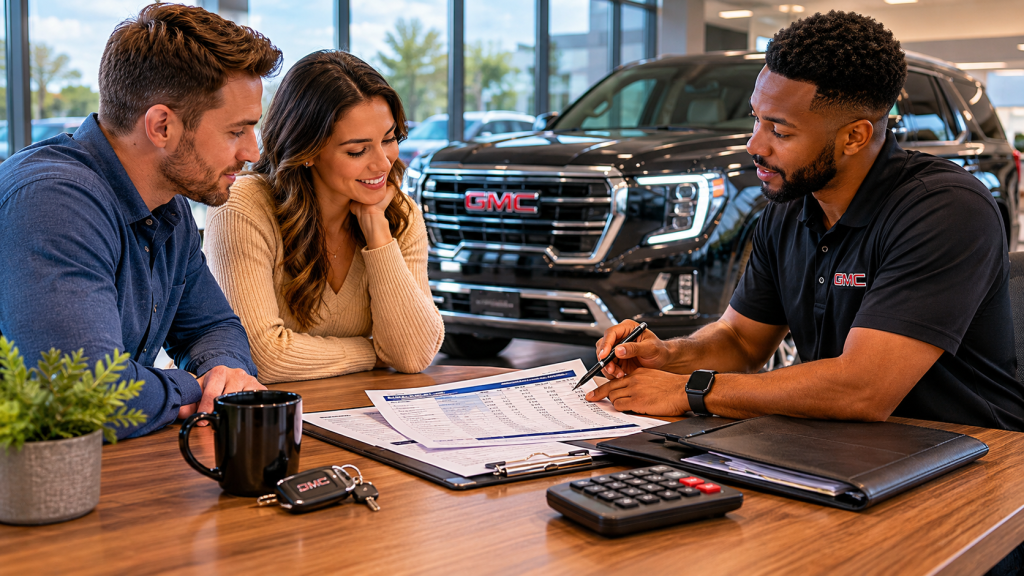
The GMC financing process involves more than choosing a monthly payment, because lenders evaluate credit history, income structure, loan length, trade in equity, and overall borrowing risk before approval terms are finalized. Buyers researching financing for a GMC truck or SUV usually want clearer expectations before visiting the dealership. They want to understand what lenders review, why payment amounts vary, and how trade ins or down payments change the overall structure of the loan. What Happens After a Financing Application Is Submitted? A financing application begins the lender review process. Once submitted, lenders analyze financial information to estimate how likely the borrower is to repay the loan over the selected term. This review includes credit history, payment history, income consistency, existing debt obligations, and the amount being financed. The GMC financing process becomes easier to understand once buyers realize lenders are calculating risk. A borrower with lower existing debt and stable payment history may qualify for different rates or term structures than someone carrying larger monthly obligations. Lenders also review the relationship between the vehicle price and the amount being borrowed. This calculation is known as loan to value ratio. For GMC shoppers near Baton Rouge, financing structure can also shift depending on whether the buyer is purchasing a Sierra, Yukon, Acadia, or another model with different pricing and loan amounts. Larger financed balances create different monthly payment calculations and lender exposure levels. Buyers should expect the financing discussion to include: more • Estimated monthly payment ranges • Loan term options • Interest rate discussion • Trade in evaluation • Down payment structure These conversations are designed to organize the financing structure into something manageable before final approval decisions are completed. Interest Rates and Loan Terms Change the Entire Loan Structure Why does loan length change the total amount paid? Loan length changes how long interest accumulates on the borrowed balance. Shorter loans usually create higher monthly payments because the balance is repaid faster. Longer loans reduce the monthly payment amount by spreading repayment across more months. The important detail is that lower monthly payments do not automatically reduce the total amount paid over the life of the loan. Extending the term allows interest to build across a longer repayment window. Interest rates are another major factor in the GMC financing process. The rate applied to the loan changes how much borrowing costs over time. Even small percentage differences can alter total repayment amounts across larger vehicle balances. This matters for buyers researching trucks and SUVs because vehicle pricing, trade in structure, and loan terms all work together. A buyer focusing only on monthly payment size may overlook how term length changes total repayment. When evaluating financing structure, shoppers should compare: • Monthly payment size • Total financed amount • Loan term length • Total estimated repayment • Interest rate differences between term options These comparisons provide a clearer picture of the financing structure instead of focusing on one number alone. Trade In Equity and Down Payment Structure What happens if a trade in still has a balance remaining? If the trade in vehicle is worth more than the remaining loan payoff amount, the difference becomes positive equity. Positive equity can reduce the amount financed on the next vehicle purchase. If the payoff balance is higher than the vehicle value, the difference becomes negative equity. That remaining balance may carry into the new financing structure depending on lender approval and financing terms. This part of the GMC financing process creates confusion because buyers sometimes focus only on trade in value without reviewing payoff balance interaction. The actual equity position comes from subtracting the remaining loan amount from the vehicle’s appraised trade value. Down payments also shape financing structure. A larger down payment reduces the financed balance immediately, which may lower monthly payments and reduce lender risk exposure. Smaller down payments create larger financed balances and may alter approval structure depending on lender guidelines. For GMC buyers researching larger SUVs or trucks, these details matter because financed amounts can shift quickly once taxes, fees, trade values, and payoff balances are combined. A financing worksheet usually includes: • Vehicle purchase price • Trade in value • Remaining payoff balance • Down payment amount • Taxes and fees • Final financed balance Reviewing these numbers together gives buyers a clearer understanding of how the financing structure is being built. Payment Planning and Budget Evaluation How do lenders calculate monthly payments? Monthly payments are calculated using the financed balance, interest rate, and loan term length. Larger balances, higher rates, and shorter repayment windows usually create higher monthly payments. The GMC financing process should also include personal budget evaluation before selecting a loan structure. Buyers need to consider insurance costs, fuel costs, maintenance planning, and existing financial obligations alongside the payment itself. This becomes important when comparing shorter and longer loan structures. A shorter term may reduce total interest paid but increase monthly financial pressure. A longer term may reduce payment size but increase the overall repayment amount across the life of the loan. Budget planning should focus on stability, not only approval. Buyers should evaluate whether the payment remains manageable alongside housing expenses, utilities, childcare, subscriptions, groceries, and emergency savings goals. The strongest financing decisions usually come from balancing: • Comfortable monthly payment range • Reasonable loan term length • Manageable total repayment • Down payment availability • Existing monthly obligations This creates a financing structure that fits daily financial routines without creating unnecessary strain later. Preparing for Financing Conversations at the Dealership What should buyers prepare before financing discussions? Financing preparation includes organizing income information, reviewing credit standing, estimating trade in position, and identifying a comfortable payment range before arriving at the dealership. The GMC financing process moves more smoothly when buyers already understand their approximate budget structure. This reduces confusion during lender comparisons and payment discussions. Most financing appointments require documentation tied to identity, residency, and income verification. Buyers should also prepare questions surrounding interest rates, lender options, term differences, and payment structure comparisons. A prepared buyer should understand: • Estimated credit standing • Approximate monthly budget target • Trade in payoff balance if applicable • Available down payment amount • Preferred loan term range These details create more productive financing conversations because both the buyer and financing team can focus on structuring the loan around realistic goals. For shoppers visiting Ross Downing GMC, financing discussions are easier when expectations are clear before numbers are finalized. Understanding how lenders evaluate applications, how rates alter repayment structure, and how equity changes financing totals gives buyers stronger clarity before signing paperwork. What Buyers Should Take Away From the GMC Financing Process The GMC financing process is built around lender risk evaluation, payment structure planning, and balancing affordability with repayment timelines. Buyers should look beyond the monthly payment alone and evaluate how rates, term length, trade equity, and financed balance interact together. A financing structure that works well should feel understandable from beginning to end. Buyers researching a GMC truck or SUV should leave the process with clear repayment expectations, confidence in the selected payment structure, and a stronger understanding of how the loan was organized.

2026 GMC Acadia Technology Updates Explained

The 2026 GMC Acadia technology setup pushes far beyond larger screens and added alerts, bringing together radar monitoring, camera visibility, connected navigation, and integrated cabin controls that change how drivers interact with a midsize SUV. Acadia shoppers are looking for more than a feature list. They want to know how the safety tech reacts, how the infotainment layout works while driving, and what to evaluate before choosing a trim. GMC Safety Assist Monitoring What does GMC Safety Assist monitor while driving? GMC Safety Assist is a collection of driver assistance features that uses sensors, cameras, and software logic to watch for lane position, vehicles ahead, potential front end collision risk, and pedestrian movement within monitored areas. In the 2026 GMC Acadia, this matters because the SUV’s size, seating layout, and family focused cabin create more situations where awareness tech needs to process information quickly. Forward collision alerts rely on front facing detection to watch closing speed between the Acadia and traffic ahead. If the closing gap gets too short, the alert logic warns the driver before braking distance becomes tighter. more Lane assistance works differently. Instead of watching traffic ahead, the camera reads visible lane markings and compares the Acadia’s position against those markings. If the SUV begins to drift without a turn signal, the steering assist can provide gentle correction. Buyers should evaluate how these alerts feel during a test drive, because the best safety setup is one the driver understands and trusts. The 2026 GMC Acadia technology story begins with that trust. Safety features should not feel mysterious. They should give drivers clearer feedback about what the SUV is reading and why an alert appears. Adaptive Cruise Control and Lane Technology How does adaptive cruise control react in traffic? Adaptive cruise control uses forward monitoring to maintain a selected speed while adjusting distance from the vehicle ahead. The Acadia’s control logic reads closing speed, gap distance, and traffic flow before easing off throttle or applying braking. This feature has a direct role for Acadia drivers who spend time on Baton Rouge highways, school routes, and longer Louisiana drives. When traffic slows, adaptive cruise control reduces speed without the driver needing to cancel cruise control. When the lane clears, the SUV can accelerate back toward the selected setting. Lane technology adds another layer. The Acadia’s lane assistance is not meant to replace steering input. It works as a corrective support feature when visible lane markings are present and the SUV begins moving away from its lane path. The driver still remains responsible for steering, braking, and roadway judgment. Shoppers should pay attention to three things during evaluation: • How smoothly adaptive cruise control slows the Acadia in traffic • How clearly lane alerts communicate lane drift • How easy it is to adjust following distance settings These details matter because driver assistance tech is only useful when it feels predictable. A large SUV with advanced alerts should still feel natural from the driver’s seat, not overly busy or hard to interpret. Infotainment Architecture and Google Built In Why are larger infotainment displays changing SUV interiors? A larger infotainment display changes how navigation, audio, climate access, smartphone tools, and camera views are organized inside the cabin. The display becomes the command center, so layout logic matters as much as screen size. The 2026 GMC Acadia technology package includes infotainment tools built around visibility, touch access, and connected services. Google built in changes the interaction model because navigation and voice commands can run through the vehicle interface rather than relying only on a connected phone. That can make route guidance, search, and voice requests feel more integrated with the SUV’s own display. The technical value comes from reduced task switching. When maps, audio, phone access, and vehicle settings live in a clear interface, the driver spends less time hunting through menus. Screen size can help, but only when the layout is clean enough to use while parked, before driving, and during quick stops. Acadia shoppers should evaluate the infotainment setup by testing simple tasks. Pair a phone, start navigation, change audio, pull up camera views, and adjust common settings. Those actions reveal more about the interface than a spec sheet can. Family Connectivity and Display Layout What should families evaluate in connected cabin technology? Connected cabin technology refers to how screens, charging access, voice controls, smartphone mirroring, and passenger needs work together during everyday trips. The Acadia is built for households that may have multiple phones, frequent navigation needs, child passengers, work calls, sports bags, and weekend gear all inside the same cabin. Wireless Apple CarPlay and Android Auto matter because cable free startup can reduce the small frustrations that happen before every drive. Once paired, the phone interface can bring maps, calls, messages, and music into the main display. Display layout also matters for families because the driver should not need to dig through menus while passengers are talking, routes are changing, or stops are being added. A good cabin tech setup keeps common controls easy to find and separates high attention tasks from simple adjustments. Before choosing a 2026 GMC Acadia, shoppers should look at: • Wireless phone pairing speed • Charging access for front and rear passengers • Visibility of navigation prompts from the driver’s seat • Ease of switching audio sources • Voice command accuracy for common requests The buyer implication is simple. Cabin tech should reduce friction before and during the drive. If the interface feels logical during a short test drive, it is more likely to support busy family routines without adding confusion. Camera Visibility Technology How does surround vision create overhead visibility? Surround vision uses multiple exterior cameras to capture different angles around the SUV, then software blends those views into a single composite image that resembles an overhead view. For the Acadia, this is important because midsize SUV drivers need to judge curbs, parking lines, tight driveways, nearby vehicles, and low obstacles that may sit outside direct sightlines. The camera view does not replace mirrors or turning your head, but it adds another layer of spatial awareness when moving at low speeds. The technical process relies on camera placement and image stitching. Each camera sees a different zone around the SUV. The software maps those camera feeds together so the driver can understand position relative to objects nearby. When paired with parking alerts, the driver gets both visual information and distance feedback. Shoppers should evaluate camera clarity in daylight, shadow, and tight parking spaces. They should also check how quickly the view appears when shifting into reverse and how easy it is to switch angles. For larger SUVs, camera quality can shape daily confidence during parking, garage entry, and crowded lots. What the 2026 GMC Acadia Technology Setup Means for Buyers The strongest technology features in the 2026 GMC Acadia are not isolated gadgets. They work best when safety alerts, driver assistance, infotainment, phone pairing, navigation, and camera views support the way the SUV is driven each day. A shopper comparing midsize SUVs should move past screen size and feature names. The better evaluation is how well the Acadia communicates information. Safety alerts should be clear. Adaptive cruise control should feel smooth. The infotainment display should make common tasks easy. Camera views should make parking and positioning easier to judge. For buyers near Ross Downing GMC, the 2026 GMC Acadia technology setup is worth testing in person because the feel of the interface matters. A test drive can show how the display responds, how driver assistance features communicate, and how connected tools fit the way the SUV will be used.

Choosing the Right GMC Trucks for Work and Weekend Use in Louisiana

Finding a pickup truck that handles both jobsite demands and weekend adventures requires more than browsing a lineup. For drivers across Hammond, Baton Rouge, and South Louisiana, GMC trucks stand out with their big presence, substantial build, and commanding capability—designed to meet real towing, payload, and driving needs from the frame up. The Sierra 1500 line, along with other distinct model lines within GMC's product lineup, showcases the brand's commitment to offering a range of trucks tailored to different needs. GMC markets its vehicles as more premium and luxury-oriented compared to Chevrolet, which targets a more mainstream audience. While Chevrolet offers a full lineup of cars and SUVs, GMC focuses exclusively on trucks and SUVs, often marketed alongside Buick and Cadillac. Fast Answer: Which GMC Truck Fits Workdays and Weekends in Louisiana? For most Hammond and South Louisiana drivers balancing work commutes with weekend boat trips or camp runs, the 2026 GMC Sierra 1500 handles the job well, setting the standard for excellence in its class by combining strength and precision. You only need to step up to the Sierra 2500HD or 3500HD when your trailer weights and payload numbers genuinely demand it. The right truck depends on three factors: how often you tow, how heavy your trailer actually is, and how much time you spend on I-12 without a load behind you. Ross Downing GMC, your local gmc dealer in Hammond, LA, helps shoppers calculate real towing and payload numbers before choosing between Sierra models. Here’s a quick self-sort: more Light boat or small utility trailer (under 7,000 lbs): Sierra 1500 Mid-size camper or equipment trailer (8,000–14,000 lbs): Sierra 2500HD Large fifth-wheel or gooseneck (15,000+ lbs): Sierra 3500HD Understanding GMC Truck Classes: Sierra 1500 vs 2500HD vs 3500HD What is the difference between the GMC Sierra 1500, 2500HD, and 3500HD? These represent half-ton, three-quarter-ton, and one-ton classifications—each with distinct frames, suspensions, and load-handling behavior that go far beyond badging. GMC and Chevrolet trucks have shared platforms since 1920, resulting in similar body designs but different branding and marketing strategies. Sierra 1500 (Half-Ton) The gmc sierra 1500 uses a lighter fully boxed high-strength and ultra-high-strength steel frame with aluminum body panels for weight savings, ensuring durability and structural integrity, including the quality of the doors. Its suspension—multi-link coil-spring in higher trims or leaf springs in base models—prioritizes a car-like ride during daily driving. Available engines include the 2.7L TurboMax, 5.3L V8, 6.2L V8, and 3.0L Duramax Turbo-Diesel. This design suits I-12 commutes between Hammond and Baton Rouge with minimal bounce, but stability decreases under sustained heavy duty towing beyond 10,000–13,000 pounds. Key features include the MultiPro Tailgate, which offers six functions for improved cargo management and bed access, and the ProGrade Trailering System, providing advanced hitch guidance and customized trailer profiles. Sierra 2500HD (Three-Quarter-Ton) The 2500HD steps up with thicker frame rails using advanced high-strength low-alloy steel. Heavier-duty leaf-spring rear suspension with increased spring rates keeps the truck level under load. Larger ventilated brake rotors up to 14.5 inches maintain composure when towing mid-size equipment trailers or bumper-pull campers. The GMC Sierra 2500 HD can achieve a maximum towing capacity of 16,000 lbs with the 6.6L Gas V8 engine when properly equipped. Sierra 3500HD (One-Ton) The 3500HD adds even beefier frame construction, optional dual rear wheels for rear axle ratings up to 10,000 pounds, and stiffer multi-leaf springs. Max towing reaches up to 36,000 lbs for fifth-wheel RVs or gooseneck horse trailers when equipped with the 6.6L Duramax Turbo Diesel V8 engine and the Max Trailering Package—essential for commercial farm work in rural Louisiana parishes. These differences are mechanical: frame steel thickness, suspension design, brake sizing, rear axle capability, and the structural quality of components like the doors. Think in terms of system strength, not just advertised numbers. How Towing Capacity and Payload Really Work on GMC Trucks Why do towing capacity and payload numbers matter so much when choosing a vehicle? Towing capacity is what the truck can pull. Payload is everything on and in the truck—passengers, cargo, tools, and the vertical weight pressing down from your trailer hitch. Engine torque, axle ratio, and cooling systems work together to determine safe limits. A sierra 1500 with the 5.3L V8 (355 hp, 383 lb-ft) and 3.42 gears tows up to 13,200 pounds but drops to around 9,500 with crew cab configurations due to higher curb weight. The 2500HD Duramax 6.6L turbo-diesel (470 hp, 975 lb-ft) with Allison 10-speed reaches 18,500 conventional and 22,500 fifth-wheel. Here’s a real-world example: Towing a 6,000-pound bass boat from Hammond to Toledo Bend adds roughly 600 pounds of tongue weight plus 800 pounds of passengers and tools. That’s 1,400 pounds of payload consumed on a 1500, leaving little margin. A 2500HD’s 3,000+ pound payload headroom provides safer control on I-12 merges and crosswind stretches. The heavier suspension, brakes, and rear axle in Sierra HD models keep the truck level and controlled near upper ratings—especially important on wet Louisiana roads. Which GMC Truck Is Best for Towing and Daily Driving Balance? Which GMC truck is best for towing while still working as a daily driver in Louisiana traffic? The answer usually starts with Sierra 1500, but shifts based on trailer weight and towing frequency. The Sierra 1500 offers balanced frame and suspension tuning for comfort on daily commutes through Hammond, Baton Rouge, and Covington. It handles common weekend loads—small campers, ATVs, boats—without issue. The Sierra 2500HD becomes the better choice when you tow mid-size travel trailers, enclosed work trailers, or equipment several times weekly. You accept a firmer ride in exchange for stability and confidence under load. The Sierra 3500HD fits drivers who regularly tow near GM’s max ratings—large fifth-wheel RVs, gooseneck horse trailers, or commercial loads—where control and durability matter more than empty-bed comfort. Example scenarios: Contractor carrying tools all week plus a side-by-side and boat on weekends: Sierra 1500 SLT or 2500HD depending on trailer size Family towing a 9,000 lb camper from Hammond to Gulf Shores: Sierra 2500HD for stability and braking confidence As a result, choosing the right GMC truck for your needs leads to improved comfort, confidence, and satisfaction whether you're towing heavy loads or navigating daily Louisiana traffic. Ross Downing GMC encourages buyers to bring actual trailer stats so the team can recommend based on numbers, not assumptions. GMC Truck Trim Levels Explained by Real Use Cases Which GMC trim level is best for work versus weekend use? Trims change how the same truck class behaves and feels, not its basic frame strength. Pro and SLE Trims These focus on practical work configurations with vinyl or cloth interiors, easy-to-clean surfaces, and cost efficiency. Ideal for jobsite duty across Hammond, Ponchatoula, and industrial areas where durability matters more than luxury. SLT and Denali Trims Tuned for comfort and long-distance towing with upgraded interior materials, advanced driver assistance, and tech that reduces fatigue on highway trips to Destin or the Smoky Mountains. These options make daily commuting more enjoyable. AT4 and AT4X Trims Off-road-focused with specialized suspension components, all-terrain tires, and underbody protection. AT4X adds exclusive Multimatic DSSV dampers and 33-inch Goodyear MT tires for 10.8-inch ground clearance—built for muddy camp roads and hunting leases. Ross Downing GMC displays side-by-side sierra trims on the lot so shoppers can feel the difference between seats, ride quality, and features before committing. Is GMC AT4 Really Worth It if You Mostly Drive On-Road? Is AT4 actually worth it for non off-road driving? AT4 is GMC’s factory off-road package available on Sierra 1500 and Sierra HD models, adding specific capability for unpaved conditions. What AT4 includes: Off-road-tuned suspension with increased ground clearance Skid plates protecting underbody components All-terrain tires designed for mud, sand, and uneven terrain Tradeoffs to consider: All-terrain tires create more road noise on highways Slightly firmer ride compared with SLT or Denali Potentially reduced fuel efficiency (1-2 mpg difference) AT4 makes sense if you frequently travel unpaved parish roads, boat launches with slick surfaces, or backwoods camps—even if most miles are on pavement. However, primarily urban or interstate drivers between Hammond, Baton Rouge, and New Orleans who only occasionally hit gravel may find SLT or Denali delivers better on-road comfort and quieter towing. Ross Downing GMC arranges back-to-back test drives so you can feel the difference before deciding. How Much GMC Truck Do You Really Need for Tools, Trailers, and Mixed Use? Do I actually need a Sierra 2500HD, or will a Sierra 1500 work for my tools and trailers? The answer combines weight, frequency, and future plans. Decision framework: Trailer typically under 7,000–8,000 lbs loaded, towing a few times monthly: Properly equipped Sierra 1500 Near 10,000–14,000 lbs or towing several days weekly: Sierra 2500HD for safer stability Fifth-wheel or gooseneck over 20,000 lbs: Sierra 3500HD, potentially DRW Regular tool loads—bed-mounted toolboxes, ladders, generators—plus passengers count toward payload. This can push some buyers into 2500HD even when their trailer isn’t extremely heavy. Think about the next 5–7 years. Upgrading to a larger camper, adding equipment, or expanding a business means sizing the truck slightly ahead of current needs makes sense. GM data shows under-speccing leads to roughly 25% higher maintenance costs from overload stress. Ross Downing GMC’s sales team reviews customer use cases and helps decide whether stepping up to a heavier class now prevents an earlier trade later. Pairing Sierra 1500, 2500HD, and 3500HD with Real Louisiana Use Cases Here’s how typical Louisiana lifestyles match to specific gmc trucks and trims: Daily commuter, Hammond to Baton Rouge, weekend boat or jet skis → Sierra 1500 SLE or SLT (payload ~1,870 lbs, tows 11,200 lbs, ~20 mpg highway) Contractor hauling tools daily, medium enclosed trailer several times weekly → Sierra 2500HD Pro or SLE (payload 3,800 lbs, exhaust brake for humid-weather stops) Family with 35-foot fifth-wheel camper, long trips to Texas or Florida → Sierra 3500HD Denali (36,000 lbs tow, air suspension levels 4,000-pound pin weight) Outdoors enthusiast, muddy hunting leases and remote fishing spots → Sierra 1500 AT4 or Sierra 2500HD AT4 (9+ inch clearance, locking diffs for mud) Drivers seeking a capable and comfortable mid-size pickup for daily use and weekend adventures → 2026 GMC Canyon (renowned for its capability and comfort as a mid-size pickup truck) Shoppers interested in a luxury electric pickup truck with advanced performance and power → 2026 GMC Sierra EV (an all-electric pickup truck that emphasizes both luxury and high-end electric capabilities) Those wanting a revolutionary electric pickup experience with supertruck performance → 2026 GMC Hummer EV Pickup (the Hummer EV pickup is an all-electric supertruck designed to redefine the electric vehicle segment, showcasing innovative design and capabilities) Each scenario ends with a clear truck and trim recommendation based on actual capability needs. GMC Truck Systems and Weekend Comfort: Ride, Braking, and Stability Truck class impacts more than numbers—it changes ride comfort, braking feel, and stability whether you’re loaded or traveling empty on Louisiana highways. Sierra 1500 suspension tuning favors a smoother, more car-like ride for everyday trips through Hammond, Denham Springs, and Metairie. When the bed is empty, you feel the difference in comfort compared to other trucks in the heavy duty class. Sierra 2500HD and 3500HD rides feel firmer without a load. But their heavier springs, shocks, and brakes excel when towing beyond 10,000 lbs on long interstate grades or in stop-and-go traffic. HD models use larger rotors and calipers that dissipate more heat under repeated braking—GM testing shows they stop from 60 mph up to 20% shorter distances when loaded near capacity compared to half-tons. Off-road suspensions and taller tires (AT4 models) slightly change handling under hard braking and quick maneuvers. This matters when towing on wet or uneven pavement common during Louisiana rainy days. Choosing the Right Trim for Long-Distance Towing and Daily Comfort SLT and Denali trims support long-distance towing and comfortable daily use beyond what work-focused trims offer. Sierra 1500 and Sierra HD SLT trims add upgraded seats, quieter cabins, and driver-assist technology that reduces fatigue on long interstate trips and daily commutes. Features like adaptive cruise that modulates throttle and brakes for trailer sway mitigation make highway traveling less stressful. Some advanced technology and driver-assist features may require linking an account to access full functionality, so users should consider privacy and account integration when using these services. Denali trims layer in premium interior materials, advanced technology including Transparent Trailer View cameras stitching 360-degree feeds for hitching, and Bose audio for road trip comfort. These don’t change core towing and payload fundamentals—they change how those capabilities feel and how enjoyable the truck is to live with. Many Louisiana buyers who work from their truck plus tow campers or boats find SLT or Denali to be the best compromise between professional use and family comfort. The space and design in these trims feels noticeably different from Pro or SLE. Financing, Trade-Ins, and Ownership Support at Ross Downing GMC Choosing the right GMC truck includes budgeting for the correct class and trim. GMC trucks are frequently sold as premium, well-featured options, and they are often sold well due to their strong appeal and build quality. Ross Downing GMC in Hammond offers financing and leasing options tailored to work-and-weekend buyers who need to balance price with capability. The dealer evaluates trade-ins—including older trucks, suvs, cars, and even vans—to help offset costs when stepping up to a Sierra 2500HD or 3500HD. This makes correctly sizing your truck realistic rather than compromising to save a small amount upfront. Certified pre-owned GMC trucks, including Sierra 1500 and Sierra HD models, are available for buyers wanting capability with added value. These are backed by GM inspections and extended warranty coverage that provide confidence. Customers from Baton Rouge, Covington, and New Orleans can pre-qualify online, review payment scenarios for different trims, and visit the Hammond showroom to finalize their selection. Additionally, the finance team can discuss whether purchasing or leasing makes more sense based on your mileage patterns and how long you typically keep vehicles. Service, Maintenance, and GM Genuine Parts for Working GMC Trucks Once you have the right GMC truck, proper maintenance keeps it performing—especially for trucks used for towing in Louisiana heat and humidity where production of heat under load is constant. Proper care helps ensure your GMC truck delivers a long and reliable life, supporting both work and personal adventures for years to come. Ross Downing GMC’s service department handles routine maintenance: Oil changes (every 7,500 miles under tow for Duramax diesels) Brake inspections and rotor checks Coolant and transmission service Tire rotations and alignment GM Genuine Parts—brakes, filters, towing components—ensure systems perform as designed under heavy load. Aftermarket parts may offer discounts initially but can compromise performance where it matters. Frequent towers should consider more regular fluid checks and brake inspections. Ross Downing GMC sets up maintenance schedules tailored to tow frequency and mileage, helping trucks last longer and maintain capability through years of combined work and weekend use. Customers can schedule service appointments online. The dealership supports both personal-use and commercial-use GMC trucks from across the Northshore region, including people traveling from New Orleans and Covington. Next Steps: Test-Drive and Spec Your GMC Truck in Hammond, LA Selecting a GMC truck means matching Sierra 1500, 2500HD, or 3500HD systems and trims to real-world work and weekend use—not just picking based on appearance. The way GMC trucks look and feel sets them apart, with a style and class that stands out on the road. June is often a peak month for truck sales, with brands like Ford and Toyota seeing high visibility, but GMC stands out for its premium appeal and attention to detail. When comparing options, Ford is a major competitor in the truck market, but GMC differentiates itself with luxury features and superior build quality. Visit Ross Downing GMC in Hammond to test-drive different truck classes and trims back-to-back. Bring your trailer weights, typical routes, and usage patterns for a tailored recommendation. The view from behind the wheel matters more than specs on a screen. Shoppers from Baton Rouge, Covington, and New Orleans can start online—browse current Sierra inventory, read through towing and payload details, and schedule a test drive. Contact the dealership to discuss whether financing, leasing, or a certified pre-owned GMC truck fits your budget and how you plan to use the vehicle through the days and miles ahead. The Ross Downing GMC team helps you avoid both underbuying and overbuying by walking through actual numbers and use cases. Find your drive—one that works for the road you take every day and the weekends that make it all worth it.


Contact Us

Fill out this form below and we'll contact you shortly
*Required Fields