



The GMC Sierra 1500 vs Sierra HD comparison comes down to one question: what does your work actually demand? Both trucks carry GMC engineering and both handle a wide range of jobs with confidence. However, they are built on different platforms for different load thresholds, and choosing between them based on spec numbers alone leads to either an underpowered workday or an over-specced daily driver. Matching the truck to the job starts with understanding what separates these two platforms at a structural level.
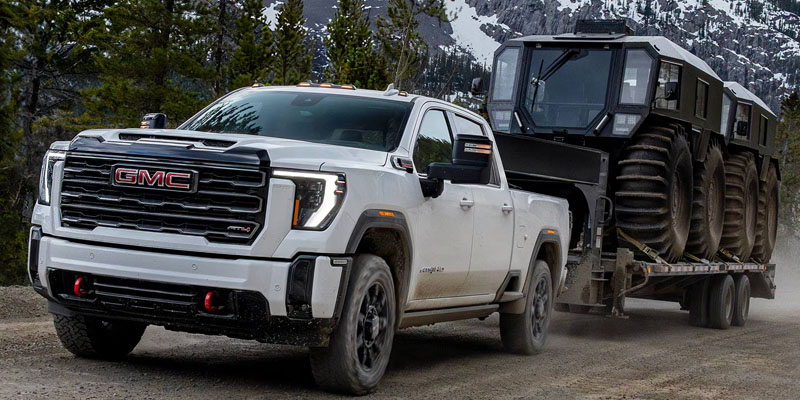
How the Sierra 1500 and Sierra 2500 HD Differ at a Structural Level
The Sierra 1500 and Sierra 2500 HD are not the same truck with a bigger engine dropped in. They are built on different architectures designed to handle fundamentally different load thresholds.
The Sierra 1500 rides on a fully boxed high-strength steel frame engineered for light-duty payloads and recreational towing. Its independent front suspension prioritizes ride comfort and handling refinement across a range of daily and weekend use scenarios. The rear axle is rated for loads appropriate to half-ton truck work, which covers the majority of personal and light commercial use cases.
The Sierra 2500 HD uses a heavier-gauge steel frame with additional crossmember reinforcement throughout. The front suspension shifts to a solid-axle setup on HD configurations, which trades some ride smoothness for the load stability required under sustained heavy commercial use. The rear axle carries a higher gross axle weight rating that supports the HD’s payload and towing ceilings. Beyond those structural differences, the 2500 HD adds a reinforced hitch receiver and the frame provisions required to support fifth-wheel and gooseneck hitch configurations that the 1500’s architecture cannot accept.
What the Gross Vehicle Weight Rating Tells You
GVWR is the total weight a truck can safely carry, including the vehicle itself, passengers, cargo, and any tongue weight from a trailer. The Sierra 1500 carries a GVWR in the range of 7,000 lbs. The Sierra 2500 HD pushes that figure well above 10,000 lbs. That gap reflects the frame, axle, and suspension differences between the two platforms. A driver who loads consistently near or above the 1500’s GVWR ceiling needs the 2500 HD’s architecture, not just its engine.
What the Towing and Payload Numbers Mean for Real Work
The Sierra 1500 tows up to 13,300 lbs when properly equipped. The Sierra 2500 HD with the 6.6L Duramax diesel reaches up to 22,390 lbs. Both numbers appear on a spec sheet, but translating them to job requirements tells a more useful story.
A payload rating matters as much as the tow rating for job-site buyers. The Sierra 1500 supports up to 2,280 lbs of payload. The Sierra 2500 HD supports up to 3,979 lbs. That difference reflects not just the frame strength but the axle and suspension capacity to carry sustained loads without degrading stability or accelerating component wear.
The following load scenarios map each truck to its appropriate job profile:
- Boat trailers under 10,000 lbs, single-axle equipment trailers, landscape trailers loaded with mowers and hand tools, and camper trailers in the mid-weight range all fall within the Sierra 1500’s capability envelope and do not require the HD platform’s additional capacity.
- Loaded gooseneck trailers carrying heavy construction equipment, fifth-wheel recreational trailers in the 18,000 to 22,000 lb range, multi-axle flatbeds with skid steers or excavators, and tandem livestock trailers loaded for transport all exceed what the Sierra 1500 can handle and require the Sierra 2500 HD’s frame, axle, and hitch architecture.
Staying within the appropriate truck’s rated capacity protects braking performance, suspension longevity, and driver safety on every haul.
Why Engine Choice Matters as Much as Tow Rating
Peak horsepower gets attention, but sustained torque at working RPM is what determines how a truck handles a full day of heavy hauling. The distinction matters most when comparing the Sierra 2500 HD’s two engine options.
The 6.6L V8 gas engine produces 401 hp and 464 lb-ft of torque. It handles the HD’s work range and covers most buyers who tow heavy loads occasionally. The 6.6L Duramax turbo-diesel produces 470 hp and 975 lb-ft of torque. However, the more meaningful figure is where that torque arrives. Diesel engines generate peak torque at low RPM, which means the truck pulls with full force from the moment the load begins to move. A gas engine builds toward its torque peak through the RPM range, which creates a momentary lag under maximum load at low speed.
For a driver pulling a loaded gooseneck out of a muddy job site, launching a heavy trailer up a boat ramp, or climbing a grade with a loaded flatbed, that low-RPM torque delivery from the Duramax removes the hesitation the gas engine cannot fully eliminate. The diesel also returns better fuel economy under sustained load, which adds up meaningfully across a full commercial work week.
The Sierra 1500’s most capable engine, the 6.2L V8, produces 420 hp and 460 lb-ft of torque. It performs well at the 1500’s towing ceiling but operates closer to its limit on consistent heavy pulls than the 2500 HD’s powertrain options do.
When Is the Sierra 1500 the Right Truck for the Job?
Buying more truck than a job requires is a real cost. The Sierra 2500 HD starts approximately $8,400 higher than the Sierra 1500 before options. Its heavier frame and solid-front-axle suspension trade ride comfort for load capacity on every mile, whether the truck is loaded or empty. Fuel economy drops compared to the 1500 in daily driving. Parking footprint and maneuverability also increase.
For buyers whose heaviest regular haul falls below 10,000 lbs, who rarely or never load the bed near maximum payload, and whose work involves a mix of job-site trips and everyday driving, the Sierra 1500 handles the work without the HD’s cost, fuel, and size trade-offs. The 1500’s available 6.2L V8 and 3.0L Duramax diesel give it genuine capability well beyond casual recreational use. A landscaper running a single-axle trailer, a contractor hauling tools and materials in a loaded bed, or a buyer towing a mid-size recreational trailer all fall comfortably within the 1500’s engineered range.
The 2500 HD becomes the right answer when loads are consistently heavy, when fifth-wheel or gooseneck configurations are required, or when the workload demands the Duramax diesel’s low-RPM torque delivery on a daily basis.
Matching Your Job Requirements to the Right Sierra
Louisiana’s work landscape places specific demands on trucks. Oil and gas operations move heavy pipe, equipment, and crew across long routes. Agriculture moves livestock and loaded hay trailers through the harvest season. Marine industries launch and recover heavy commercial vessels. Construction sites load trucks to their rated limits week after week. Each of those scenarios maps to a different point on the Sierra capability range.
The following job profiles point each buyer toward the right Sierra tier:
- Buyers who haul landscape or lawn care equipment on a single-axle trailer, transport tools and materials in the bed for light to moderate construction work, tow a fishing boat or recreational camper under 10,000 lbs, or use their truck primarily for daily driving with occasional weekend loads will find the Sierra 1500 covers every requirement without the HD’s added cost or weight.
- Buyers who pull fifth-wheel or gooseneck trailers loaded with construction equipment, livestock, or heavy recreational rigs, run loaded flatbeds or tandem-axle trailers consistently, work in oil field or agricultural operations that require maximum payload capacity on a daily basis, or need the Duramax diesel’s torque for repeated heavy-load starts on grades or soft ground need the Sierra 2500 HD’s architecture to do the job safely and reliably.
Both trucks are built to work. The Sierra 1500 handles more jobs than most buyers need it to. The Sierra 2500 HD handles the jobs that nothing else can. Knowing which category your workload falls into is how you drive away from the lot in the right truck.
Connect with us


